
You can grow your federal contract portfolio without posting a single job listing. The path is strategic subcontracting, specifically, partnering with specialized AV integrators who bring the technical depth, certifications, and compliance infrastructure your agency clients need.
This post covers why that model is gaining ground fast, what it looks like in practice, and how to evaluate whether your firm is leaving scope on the table.
Why Federal Contractors Are Rethinking the Headcount Model
The pressure to expand is real. Federal contract obligations rose by about 29% from FY2019 (~$586B) to FY2024 (~$755B). Yet many buyers are also pushing consolidation and contract-based purchasing, and the supplier base has been tightening in parts of the market. That concentration makes it harder to win net-new primes on capability alone. Mid-sized contractors must compete smarter, not just harder.
Hiring feels like the obvious answer. You land a contract that includes AV integration, command center buildouts, or secure video conferencing. You think you need a team. But technical AV talent is expensive, scarce, and hard to retain between contract cycles.
The problem isn’t just cost. It’s timing. By the time you’ve hired, trained, and cleared personnel, your delivery window is already compressed.
The more efficient path is to bring in an established AV integration partner as a subcontractor before you bid. That way, capability becomes part of your proposal, not a gap you’re trying to close after award.
The Subcontracting Shift Is Structural, Not Temporary
With prime opportunities declining, contractors are turning to more subcontracting to complete work and qualify for more opportunities.
The federal small-business goals keep real pressure on acquisition strategies. Small Business Administration sets a 23% governmentwide goal for small business prime contracts, and the Department of Defense FY2025 small business prime goal is 23.17% of all DoD spending.
That reality pushes larger primes to build strong subcontractor relationships. AV integration, because it touches collaboration spaces across facility types, often provides a practical place to add a compliant scope through partnership.
What AV Scope Looks Like Inside a Federal Contract
This is where a lot of prime contractors underestimate the opportunity. AV isn’t just conference rooms. In federal environments, AV integration spans command and control centers, classified briefing rooms, training facilities, courtrooms, and multi-site collaborative networks. These spaces require specialized design, precise equipment specification, and deep familiarity with how government procurement works.
The agencies don’t just want screens on walls. They want systems that are compliant with IT security frameworks, documented for audit, integrated with platforms like Microsoft Teams Rooms or ZoomGov, and maintained long after installation.
The Compliance Layer Is Where Most Primes Get Stuck
Modern government AV must align with cybersecurity posture, not just room functionality. Signal paths, audio masking, device hardening, boundary definitions, and access controls aren’t details you can bolt on at the end. For prime contractors trying to absorb this scope internally, it’s a serious delivery risk.
Working with a qualified AV subcontractor changes that calculus entirely. Firms like ours that specialize in government AV integration plan for compliance from the first design session, not the final punch list. Documentation, framework alignment, and IT security artifacts get built into the process. That way, your delivery team isn’t scrambling to answer questions from the agency’s cybersecurity office during commissioning.
What a Real Partnership Model Looks Like
Pre-Bid Support That Actually Wins Business
One of the most underrated advantages of bringing in an AV subcontractor early is proposal quality. Assumption-based scopes, structured clarifications, and accurate bill-of-materials estimates are hard to produce if AV isn’t your core competency. A seasoned AV partner can develop buildable drawings and realistic pricing that protects your margin and gives your proposal technical credibility that a generalist response can’t match.
We’ve seen this dynamic play out repeatedly in our work supporting prime contractors in federal environments. The primes that bring us in during capture, not post-award, consistently submit stronger technical volumes and experience fewer scope surprises during execution.
Execution Without the Management Overhead
Once a contract is awarded, the PM burden on a prime can be significant. Multi-vendor coordination, schedule management, and agency stakeholder communication stack up fast. An experienced AV subcontractor should be running their own workstream with discipline: weekly coordination, documented decisions, real-time risk flagging, and updates you can pass directly to the contracting officer.
That’s what low-burden delivery means. Not just doing the work, but doing it in a way that doesn’t create drag on your program team.
A few things a capable AV subcontractor handles independently:
- Equipment procurement and lead time planning
- Site surveys and facility coordination
- System programming, testing, and commissioning
- Post-installation support and AV maintenance
This matters, especially in multi-site or phased programs. Contract platforms like Alliant 3 cover a broad IT scope and often drive teaming for specialized capabilities. And demand on Alliant 2 was strong enough that GSA raised its ceiling to $75B, while also calling out an added small-business subcontracting opportunity tied to that growth. If you’re positioned on a major contract platform, delivering an AV scope cleanly without adding headcount becomes a real differentiator.
When to Bring in an AV Subcontractor
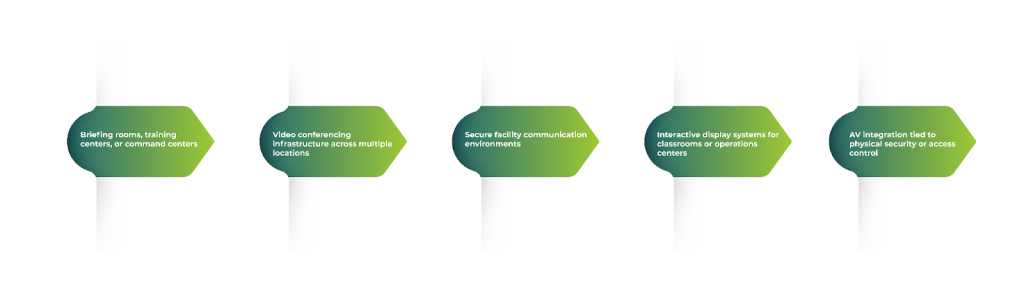
Not every contract warrants it, but there are clear signals. If the statement of work includes any of the following, it’s worth a conversation:
- Briefing rooms, training centers, or command centers
- Video conferencing infrastructure across multiple locations
- Secure facility communication environments
- Interactive display systems for classrooms or operations centers
- AV integration tied to physical security or access control
AV integration is a challenging niche with a high entry point in terms of skill and experience, but the rise of collaborative digital work environments means your clients need AV solutions for the future. That demand isn’t going away. Federal agencies are modernizing facilities, upgrading hybrid work infrastructure, and investing in secure collaboration technology at a consistent pace.
The question isn’t whether the AV scope will appear in your future bids. It’s whether you’re positioned to respond to it without scrambling.
Build Capability Without Building a Department
Growing your federal service offerings doesn’t require growing your org chart. It requires the right partnerships, ones that give you real technical depth, compliance credibility, and delivery reliability that your agency clients can count on.
We’ve spent 30+ years working alongside government prime contractors on complex AV programs, from secure command centers to multi-campus training facility buildouts. Our teams know how federal contracts work, what agencies expect, and how to deliver without creating noise for your program office.
Ready to expand what you can offer? Contact us to talk through what AV partnership support looks like for your next proposal or active contract.

Jarrett Lowman
Jarrett Lowman is the Vice President of Sales at Applied Global Technologies (AGT), where he has spent 20 years rising from Lead Solutions Architect to sales leadership. An AVIXA Certified Technology Specialist (CTS) and Crestron Master Sales Associate, he specializes in AV integration and secure collaboration systems for federal, healthcare, and commercial clients.